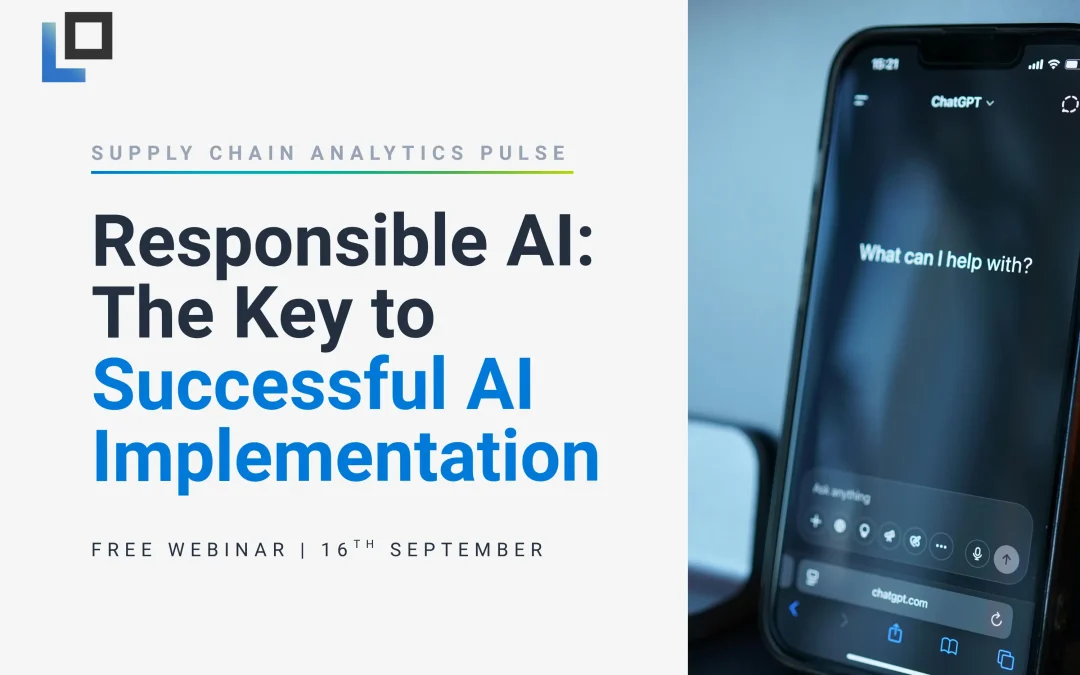
Supply Chain Analytics Pulse Goes Live for a Webinar on Responsible AI

Supply Chain Analytics Pulse Goes Live for a Webinar on Responsible AI

News

Supply Chain Analytics Pulse Goes Live for a Webinar on Responsible AI

September 2026 | Supply Chain Analytics Pulse

Supply Chain Analytics Pulse will host a live webinar on responsible AI in supply chain and logistics. The session will take place on September 16, 2026, led by AI expert Michael Alf to address the oversight gaps and accountability blind spots shaping AI adoption in the industry.

AI adoption in supply chain and logistics is picking up pace, with tools now automating decisions, flagging anomalies, optimizing routes, and predicting demand. Governance and oversight often struggle to keep pace. Organizations getting the most value from these tools tend to share a clear view of what their AI systems are doing, defined accountability for when something goes wrong, and processes to catch problems before they reach customers or regulators. 

Over one hour, AI expert Michael Alf will cover the AI risks most often overlooked in logistics contexts, the accountability gaps behind the most common failure points, and a governance approach that teams without a dedicated AI function can put into practice, along with ways to use AI more confidently in daily operations. The session is designed to be practical and directly applicable the following day.

🔎​ Just exploring? Get FREE Supply Chain Analytics Pulse insights in your inbox.

Subscribe to Supply Chain Analytics Pulse for bi-weekly announcements of the latest supply chain research, trends, and best practices.

The Supply Chain Analytics Pulse is a biweekly written publication that gives supply chain and logistics professionals deep dive analysis on the issues shaping day-to-day decisions, recently covering topics such as carrier selection risk and safety stock behaviour after tariff volatility. Once each quarter, Log-hub opens a live session in its place, inviting AI expert Michael Alf to lead a deeper conversation with its Pulse audience. Questions and themes raised during the webinar carry into future written editions, extending the discussion further into AI applications for supply chain and logistics professionals.  

Ritik Luthra

Ritik Luthra, CTO of Log-hub, comments:

AI is already part of daily decision making across supply chain and logistics. The organizations that get real value from it are the ones that also know how to govern it. That is exactly the kind of applied insight we want our Pulse audience to walk away with.

Save your seat for the September 16, at 2PM CEST webinar at registration link and bring your questions for Michael Alf. 

Catch up with our latest news

Log-hub Launches 3D Container Loading App to Cut Containers and Costs Through Real-World Load Planning 

Log-hub Launches 3D Container Loading App to Cut Containers and Costs Through Real-World Load Planning 

News

Log-hub Integrates Supply Chain Apps with Claude and ChatGPT

August 2026 | Log-hub 6.3 Release

Log-hub has launched its 3D Container Loading App as part of the latest release, helping supply chain teams use container space more efficiently and lower transportation costs through load planning that accounts for real-world constraints such as product rotation and stacking limits.

Average container utilization on inbound shipments is often estimated at around 65%, meaning close to a third of the space companies pay for goes unused. The 3D Container Loading App is designed to address this shortfall, by optimizing how shipments are packed while respecting real-world constraints such as how much weight a package can carry on top of it and how much a container can carry in total. 

Users enter package dimensions and quantities together with the constraints that already govern the load. Whether items can be rotated, how many identical units can be safely stacked, and which products must be kept apart. The app incorporates these requirements directly into the loading plan, helping planners make better use of available space while avoiding layouts that cannot be executed in practice. 

🔔 Don’t miss a thing

Get product updates, release highlights, and supply chain insights delivered to your inbox.

Subscribe now

The 3D Container Loading App tests eight different packing strategies against each shipment to identify the best-performing loading options for its specific combination of package dimensions, quantities, and loading constraints. The dashboard shows the best performing results, together with a ready loading plan that can be used directly on the warehouse floor. 

By testing multiple packing approaches for each load, the app helps planners arrive at a practical loading arrangement without manually working through different layouts. On real shipments, that regularly comes down to fewer containers booked for the same freight. 

Alexander Sigmund

Jan Sigmund, CEO of Log-hub, comments:

What’s different here is that this app’s recommendations can be executed on the dock, which is what turns better math into lower transportation costs, better use of the fleet already on the road, and more reliable operations. That’s the standard we want every Log-hub tool to meet.

The 3D Container Loading App joins a growing portfolio of more than 40 Supply Chain Apps covering network design, routing, and inventory planning. It is available, and teams can start planning their next shipment today with Log-hub’s Freemium Plan, which gives full access to Supply Chain Apps within a fair-use cap. 

Catch up with our latest news

Log-hub Brings Supply Chain Apps Directly into Claude and ChatGPT 

Log-hub Brings Supply Chain Apps Directly into Claude and ChatGPT 

News

Log-hub Integrates Supply Chain Apps with Claude and ChatGPT

August 2026 | Log-hub 6.3 Release

Log-hub now enables supply chain professionals to run Supply Chain Apps analyses directly from Claude and ChatGPT, using only a Supply Chain Apps API key and a free Claude or ChatGPT account. 

AI assistants have increasingly become part of how supply chain teams work. Yet the underlying analysis often remains split across specialist planning software, spreadsheets, and AI tools. Log-hub’s new integration closes that gap. 

Now, users can connect Supply Chain Apps to Claude or ChatGPT with an API key, then upload a cost file, demand file, or other data, combine it with existing analyses, validate results, compare scenarios, and generate charts, dashboards, and presentation-ready outputs, all in one conversation, with no software installation or separate integration project required. Results can be saved directly to the Log-hub platform, so colleagues can pick up the same analysis later. 

🔔 Don’t miss a thing

Get product updates, release highlights, and supply chain insights delivered to your inbox.

Subscribe now

The same applies in Excel. Users can run Claude for Excel alongside them to build or clean the datasets feeding into their analysis. 

This changes how people work. Planning managers can check recommendations against the latest data before presenting to leadership, and analysts spend less time moving figures between systems and more time testing scenarios. Claude and ChatGPT handle the conversation, while Supply Chain Apps still runs the calculations, so accuracy and traceability don’t change. 

Alexander Sigmund

Alexander Sigmund, CTO of Log-hub, comments:

Claude and ChatGPT are already where a lot of analytical thinking happens day to day. Instead of asking teams to export data from Supply Chain Apps and paste it somewhere else, we brought Supply Chain Apps to where that thinking is already taking place. This removes friction from supply chain analysis and lets planners focus more on the decisions behind the data.

This integration brings Log-hub’s supply chain analysis directly into the AI tools planners and analysts already use, while maintaining the same numbers and analytical rigor they expect from Supply Chain Apps 

Catch up with our latest news

Log-hub Integrates Supply Chain Apps with Claude and ChatGPT and Introduces 3D Container Loading App

Log-hub Integrates Supply Chain Apps with Claude and ChatGPT and Introduces 3D Container Loading App

News

Log-hub Integrates Supply Chain Apps with Claude and ChatGPT and Introduces 3D Container Loading App

August 2026 | Log-hub 6.3 Release

Log-hub’s latest Supply Chain Apps update release brings advanced supply chain analysis closer to everyday planning, combining direct access through Claude and ChatGPT with a new 3D Container Loading App and more realistic freight and network modelling.

Supply Chain Apps Connect with Claude and ChatGPT

Users can now connect Supply Chain Apps directly with Claude or ChatGPT using their Supply Chain Apps API key, with only a free Claude or ChatGPT account required.

From the AI environment they already use, teams can combine external and internal data with Supply Chain Apps analyses, validate previous results, compare scenarios, and create dashboards, maps, and presentation-ready outputs. Results can then be saved to a Log-hub workspace for further analysis and collaboration.

Alexander Sigmund

Alexander Sigmund, CTO of Log-hub, comments:

The real opportunity with AI in supply chain is not simply getting faster answers. It is giving AI access to the right analytical capabilities so those answers can support real decisions. This release is an important step in that direction.

3D Container Loading Reflects Real Loading Conditions

The new 3D Container Loading App extends traditional two-dimensional packing into a three-dimensional loading environment, helping teams plan shipments closer to how they are loaded in real life. Alongside package dimensions and quantities, it considers practical restrictions such as orientation, stacking, weight limits, container capacity, and product compatibility.

The application evaluates different packing approaches to maximize container utilization while reducing the number of containers required. The result is an optimized loading plan and detailed shipment manifest that can be used directly by warehouse and logistics teams, reducing manual planning while helping ensure that optimization recommendations are feasible in practice.

🔔 Don’t miss a thing

Get product updates, release highlights, and supply chain insights delivered to your inbox.

Subscribe now

Improvements Across Supply Chain Apps

The release also introduces improvements across freight planning, network design, optimization, and platform administration. Freight Matrix Plus can now automatically assign freight zones and account for shipment-specific surcharges and discounts, helping teams build cost analyses that better reflect actual carrier agreements.

Improvements to the Admin Center simplify application access management across growing organizations, while redesigned Network Design dashboards make scenarios and key KPIs easier to explore. Shipment Flow Optimizer and Supply Chain Designer also introduce warehouse processing times and facility constraints, allowing teams to model networks that more closely reflect real operating conditions.

This release also includes continuous performance improvements powered by the new Hexaly solver, enabling faster calculations, higher-quality optimization results, and support for even larger datasets.

Together, these improvements reduce manual effort, bring analysis closer to operational reality, and make it easier for teams to move from planning to informed decision-making.

Catch up with our latest news

Log-hub Introduces a New Offer to Support Small Supply Chain Consultancies

Log-hub Introduces a New Offer to Support Small Supply Chain Consultancies

Log-hub is introducing a new offer for supply chain consulting teams of up to 10 people, providing 12 months of free access to its Supply Chain Apps portfolio, alongside a 50% commission when clients are referred to Log-hub.

For consultants, this creates an opportunity to access Log-hub’s complete Supply Chain Apps Portfolio, including Premium Apps, for 12 months at no cost. Besides delivering projects themselves, small consultancies now also have the tools to support the pitching phase. The flexibility to explore different use cases and select the right analytical approach for each client removes the challenge of having to build a separate technology setup for every project. 

Alongside free access to the Supply Chain Apps portfolio, consultants receive a 50% commission when a referred client purchases a Log-hub license 

Supply chain consultants often move between very different client challenges, from winning the pitch to delivering the project. Supply chain apps cover supply chain visualization and network designtransport optimizationinventory planning, and CO₂ analysis in one environment. Consultants can use them to run an initial analysis, visualize potential outcomes, and bring concrete numbers and scenarios into the pitch. Once the engagement moves forward, the same apps support deeper analysis and scenario evaluation throughout project delivery, without requiring specialist technical skills. 

Ritik Luthra

 Consultants create the most value when they can combine their expertise with the right analytical capabilities at the right moment. With this offer, we want to give smaller consulting teams the freedom to use our entire Supply Chain Apps portfolio across their projects, while also rewarding them when the solutions they introduce continue creating value for their clients.

Jan Sigmund, CEO of Log-hub 

By combining 12 months of free access with a 50% referral commission, Log-hub’s new offer extends the opportunity beyond access to technology alone. Consultants can use the same toolkit from initial analysis and client pitches through scenario evaluation and final recommendations, while creating an additional revenue stream when clients choose to continue using Log-hub. 

Catch up with our latest news

Log-hub Helps Manufacturers Find Hidden Savings with Expanded Cost Savings Programme 

Log-hub Helps Manufacturers Find Hidden Savings with Expanded Cost Savings Programme 

Log-hub expanded its Cost Savings Programme with 25 structured initiatives that help industrial manufacturers capture savings hidden in planning decisions, that even heavily automated plants still leave largely unreviewed.

Manufacturers have spent the past several years digitizing production through investments in sensors, predictive maintenance, robotics, and industrial automation. Yet the planning processes that shape network costs, inventory, sourcing, and transportation, however, have often evolved more slowly. 

Dirk Reich

You can put sensors on every machine on the floor and still lose money in decisions nobody re-examines. Most of what we find isn’t on the floor. It’s upstream, in planning that hasn’t been looked at since it was set up.

Dirk Reich, Chairman of the Board

The 25 cost savings initiatives are organized across six planning areas, including demand, supply, inventory, production, logistics and integrated planning. Two are getting particular attention right now: the US Tariff Evaluation Engine, which maps a product’s material composition against country-of-origin rules to flag tariff exposure before a shipment gets blocked, and Production Location Planning, which simulates the full cost impact of moving production between regions before a manufacturer commits to it. 

“A list of opportunities is only worth something if it changes what a manufacturer does on Monday morning,” Reich added. “We don’t hand over a report and leave. We work through a client’s own data, agree on where the numbers actually point, and stay through implementation.” 

According to Log-hub, most operators already possess the data needed to identify significant savings opportunities. The challenge lies in bringing together fragmented operational and financial data into a structured framework that supports better decision-making. 

Engagements begin with a no-cost qualification call, followed by a joint assessment of the manufacturer’s planning data to identify optimization potential. Based on these findings, Log-hub develops a tailored proposal with clearly defined savings objectives and supports implementation while continuously tracking performance after go-live.  

Log-hub’s broader point is simple: for most manufacturers, the money isn’t gone, it’s just never been looked at closely enough to find. Manufacturers ready to see how much of that applies to their own operations can reach Log-hub’s supply chain expert Divya at divya.gautam@log-hub.com or book an introductory call. 

Catch up with our latest news

Recieve the Literature by e-mail!

Recieve the Literature by e-mail!

Share with us your e-mail address in order to receive the resource.

You have Successfully Subscribed!