
Supply Chain Analytics Pulse, the free research published by supply chain software company Log-hub, has released a new analysis of hyperautomation that goes beyond explaining what’s changing, it helps readers assess where they stand today and decide what actions to take next.

The latest edition, What Is Hyperautomation, and Why It’s Becoming Supply Chain’s Operating System, illustrates this approach. Rather than simply reporting that the global hyperautomation market is projected to grow from $55.54 billion in 2025 to $235 billion by 2034, the edition translates that market outlook into practical frameworks readers can apply immediately.
The first is a maturity self-assessment: a five-level matrix, inspired by Gartner’s maturity framework, that helps organizations evaluate their progress across process and data, technology stack, decision autonomy, governance and ethics, and organizational readiness. The framework highlights governance as an area where many manufacturing and logistics organizations lag their technology adoption, creating a gap that can slow automation initiatives.
The edition also includes separate action plans for executives and analysts, allowing readers to focus on recommendations relevant to their role. The executive track focuses on readiness audits, ROI ownership and board-level governance, while the analyst track provides practical guidance for implementation, automation opportunities and operational execution. The goal isn’t just role-specific advice, it’s keeping executives and analysts on the same page, so strategy and execution move together.
The edition backs both tools with verifiable examples rather than hypotheticals: Unilever’s Manufacturing System, live across 124 factories, and a 2026 fairness study grounding the governance argument in data rather than speculation. The full piece breaks both down in detail.
Together, the maturity assessment, role-specific guidance and supporting research are intended to help organizations move beyond understanding hyperautomation to planning its practical adoption.

Too much industry content tells readers what’s changing without helping them decide what to do about it. We created Supply Chain Analytics Pulse to bridge that gap. With separate guidance for executives and analysts built on that same assessment, they can move together.
Ritik Luthra, COO at Log-hub
This latest edition, “What Is Hyperautomation, and Why It’s Becoming Supply Chain’s Operating System,” is available exclusively to subscribers. Subscribing is free and gives readers access to this edition, the full archive of previous editions, and future issues covering AI, network design, demand forecasting, sustainability and other key supply chain topics.
Catch up with our latest news
Log-hub Lets Supply Chain Teams Stress-Test Inventory Policies Against Uncertain Demand
NewsLog-hub Lets Supply Chain Teams Stress-Test Inventory Policies Against Uncertain Demand October 2026 | Log-hub 6.4 ReleaseLog-hub advances its Inventory Simulation App with a stochastic mode, enabling supply chain teams to test inventory policies against multiple...
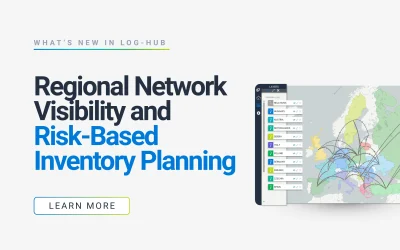
Log-hub’s Supply Chain Apps Brings Regional Network Visibility and Risk-Based Inventory Planning
NewsLog-hub's Supply Chain Apps Brings Regional Network Visibility and Risk-Based Inventory PlanningSeptember 2026 | Log-hub 6.4 Release Log-hub has introduced custom map hierarchies and stochastic mode in the Inventory Simulation App, as part of its Log-hub 6.4...
Log-hub CEO Jan Sigmund Discusses AI and the Democratization of Supply Chain Analytics on Supply Chain Connect Podcast
NewsLog-hub CEO Jan Sigmund Discusses AI and the Democratization of Supply Chain Analytics on Supply Chain Connect Podcast September 2026 | AI in Supply ChainLog-hub CEO Jan Sigmund joined host Tyler Fussner on the Supply Chain Connect podcast for a wide-ranging...

Recent Comments