
Log-hub expanded its Cost Savings Programme with 25 structured initiatives that help industrial manufacturers capture savings hidden in planning decisions, that even heavily automated plants still leave largely unreviewed.

Manufacturers have spent the past several years digitizing production through investments in sensors, predictive maintenance, robotics, and industrial automation. Yet the planning processes that shape network costs, inventory, sourcing, and transportation, however, have often evolved more slowly.

You can put sensors on every machine on the floor and still lose money in decisions nobody re-examines. Most of what we find isn’t on the floor. It’s upstream, in planning that hasn’t been looked at since it was set up.
Dirk Reich, Chairman of the Board
The 25 cost savings initiatives are organized across six planning areas, including demand, supply, inventory, production, logistics and integrated planning. Two are getting particular attention right now: the US Tariff Evaluation Engine, which maps a product’s material composition against country-of-origin rules to flag tariff exposure before a shipment gets blocked, and Production Location Planning, which simulates the full cost impact of moving production between regions before a manufacturer commits to it.
“A list of opportunities is only worth something if it changes what a manufacturer does on Monday morning,” Reich added. “We don’t hand over a report and leave. We work through a client’s own data, agree on where the numbers actually point, and stay through implementation.”
According to Log-hub, most operators already possess the data needed to identify significant savings opportunities. The challenge lies in bringing together fragmented operational and financial data into a structured framework that supports better decision-making.
Engagements begin with a no-cost qualification call, followed by a joint assessment of the manufacturer’s planning data to identify optimization potential. Based on these findings, Log-hub develops a tailored proposal with clearly defined savings objectives and supports implementation while continuously tracking performance after go-live.
Log-hub’s broader point is simple: for most manufacturers, the money isn’t gone, it’s just never been looked at closely enough to find. Manufacturers ready to see how much of that applies to their own operations can reach Log-hub’s supply chain expert Divya at divya.gautam@log-hub.com or book an introductory call.
Catch up with our latest news
Log-hub Lets Supply Chain Teams Stress-Test Inventory Policies Against Uncertain Demand
NewsLog-hub Lets Supply Chain Teams Stress-Test Inventory Policies Against Uncertain Demand October 2026 | Log-hub 6.4 ReleaseLog-hub advances its Inventory Simulation App with a stochastic mode, enabling supply chain teams to test inventory policies against multiple...
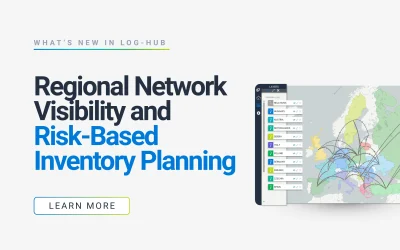
Log-hub’s Supply Chain Apps Brings Regional Network Visibility and Risk-Based Inventory Planning
NewsLog-hub's Supply Chain Apps Brings Regional Network Visibility and Risk-Based Inventory PlanningSeptember 2026 | Log-hub 6.4 Release Log-hub has introduced custom map hierarchies and stochastic mode in the Inventory Simulation App, as part of its Log-hub 6.4...
Log-hub CEO Jan Sigmund Discusses AI and the Democratization of Supply Chain Analytics on Supply Chain Connect Podcast
NewsLog-hub CEO Jan Sigmund Discusses AI and the Democratization of Supply Chain Analytics on Supply Chain Connect Podcast September 2026 | AI in Supply ChainLog-hub CEO Jan Sigmund joined host Tyler Fussner on the Supply Chain Connect podcast for a wide-ranging...

Recent Comments